
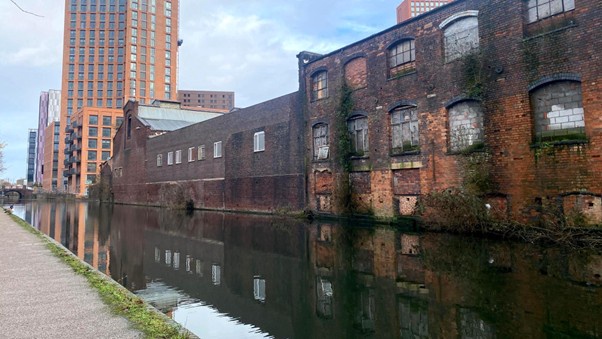
Walking alongside Birmingham’s canals can be a serene and peaceful experience. Birmingham famously has more miles of canals than Venice, but they don’t dominate the landscape. They sit quietly just out of sight.
You can live or work in Birmingham city centre but never see them. They run just below street level, often tucked away behind buildings, and unknowingly passed by people every day. And because they tend to remain hidden, there are things they can reveal that normal streets don’t.
At Gas Street Basin, everything feels calm. Water reflects off brickwork and glass. Restaurants line the edges of the canal. People pass to and fro. Boats sit patiently. Just an ordinary day in the city.
But canals can be routes to other places, and the moment you start walking, they begin to show you versions of the city that might be very different from the ones you know.
A city of contrasts
To begin with, the canal is surrounded by leisure. People lounge outside cafés, cyclists glide along on the towpath, and the water moves slowly and lazily, carrying splintered reflections of a Birmingham that feels confident, modern and complete.
But as you continue on, you start to see a subtle change. The canal edges roughen, the leisure activities thin out, and the buildings begin to look more careworn.
The canal’s history
It’s easy to forget why these waterways were built.
The first canal into Birmingham opened more than 250 years ago in 1769, during the Industrial Revolution. With automation still a long way off, the canal was dug entirely by hand: carved out with shovels, sweat, labour, and ambition.
Before the arrival of steam engines, freight transport on the canals in the UK (and elsewhere) were reliant upon horse-drawn boats. These boats were necessarily limited in speed and could only carry heavy loads as fast as the horses could haul them. Later on, however, saw the emergence of steam-powered canal boats, significantly improving the speed, efficiency and reliability of transporting goods across the canals.
As well as powering the canal boats, steam engines were used to improve the canal infrastructure, particularly in areas where water levels needed to be managed. They were used to pump water into the canals, particularly in places where water levels were difficult to maintain naturally.
These canals carried coal, iron, and other goods across the region and were an early and essential element of the UK’s logistics infrastructure.
Because the canals were meeting an increasing demand for the efficient flow of goods, they influenced the shape of the landscape around them, attracting factories, storage facilities and distribution centres.
While the use of steam initially brought enormous benefits to the canal transport network, railways (which also relied on steam) ultimately had a much greater long-term impact on the canals.
By the early to mid-19th century, the development of steam-powered railways had led to a burgeoning railway network across the UK. The railways offered much faster and more direct ways of transporting goods over longer distances, particularly for bulk materials such as coal, iron and manufactured goods.
As the railways continued to expand, the canals began to lose their competitive edge in terms of freight transportation. By the late 19th and early 20th centuries, their decline had become increasingly evident, with the railways proving much more efficient and lacking the navigational constraints of the canals.
Despite their decline, the fact that canals were built so long ago with such basic tools - shovels, picks, wheelbarrows and muscle power - is a testament to the sheer determination, skill, and ingenuity of the workers involved. It’s mind-boggling to think about how much manual labour went into creating these waterways, which have lasted for centuries!
As well as contending with the physical labour, the men who built these canals (“the navvies”) faced diseases like cholera, dysentery, and typhoid, and respiratory infections from poor sanitation. Exhaustion from long hours of physical strain, exposure to harsh weather, accidents due to gunpowder explosions during blasting work, injuries from using heavy tools, poor living conditions in overcrowded camps with little food or medical care, and mental strain from fatigue and despair all took their toll.
The Brindley Canals, which were part of the early canal network in Birmingham, were built by thousands of workers in the 18th century under the guidance of engineer James Brindley. The high death toll among these workers is well-documented, although records from the time were not always comprehensive. In many cases, poor treatment and a lack of basic medical care meant that workers died from relatively simple injuries or illnesses that would easily be treated today.
Empty Properties along the water
On reaching Lower Loveday Street, you realise that the canal has quietly led you to somewhere very different from where your journey started.
The canal’s polished edges have given way to something much more exposed:
- Boarded up windows
- Derelict brickwork.
- Spaces that no longer have any defined purpose.
This is the part that interests us the most.
A line of tents is visible, temporary abodes stretching away alongside infrastructure that has been there for centuries.
The contrast builds slowly, step by step, until you realise that you’re no longer walking through the Birmingham that most people see. The canal has led you here, and it continues onwards.
If places like this interest you…
Join our community of Land Heroes by downloading our free Land Hero app.
It allows anyone to upload derelict or under-used land and buildings, helping to bring overlooked places back into focus, and offering them the chance of a new life.
If you join us, you will be rewarded for your input financially, environmentally and socially.