
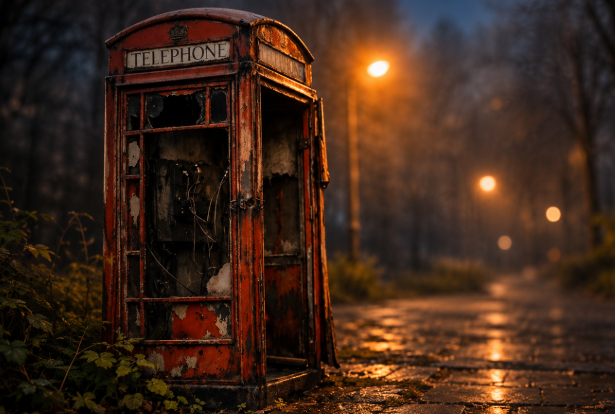
Traditional red telephone boxes are still a familiar feature in our towns and cities. These iconic structures once played a vital part in people’s everyday lives, allowing them to keep in contact long before the arrival of the mobile phone network and instant messaging. Today, many have been disconnected from the network and rendered obsolete. There are countless numbers of them standing empty, and showing all the classic signs of dereliction after years of limited use: rusted ironwork and broken windows.
As mobile phones have become commonplace, the decline of the public telephone box has been a nationwide phenomenon. At one time there were 92,000 phone boxes across the UK. Today many of these have fallen out of use, leaving communities, local authorities, and property owners with the challenge of finding new purposes for these structures that once served us so well.
Listed status and heritage protections
At first glance, old telephone boxes appear to be little more than historic relics; passed by without a second glance. In fact, many of them are Grade II listed, and are recognised for their architectural and structural significance. Given their protected status, any future development would need to respect their historic character, but that doesn’t mean that they are destined to remain empty forever.
The idea that listed buildings must remain unchanged is a popular misconception.
In reality, sensitive adaptations are encouraged, providing they help to preserve a building's long-term future. In many cases, the distinctive character, instantly recognisable design, and prominent locations of former telephone boxes mean there is a unique opportunity for reimagining how they can contribute to modern communities.
The solution: ‘Adaptive Re-use’
You may be wondering what kind of use could possibly fit into such a small space! But their snugness is precisely what makes these structures so appealing. While their limited footprints might appear restrictive, they encourage more creative and imaginative solutions. Across the country, old telephone boxes have been reborn as community libraries, coffee kiosks, art galleries, information points, and even museums. Each project has demonstrated how small, empty spaces can still have considerable social, cultural, or commercial value, if approached with some imagination.
Many telephone boxes are in highly visible locations with significant pedestrian footfall. Their presence in town centres, commercial districts, transport hubs, and community spaces creates opportunities for uses that will engage all residents: workers, and tourists alike. Whether these future uses will be a cultural installation, a retail concept, a community initiative, or something entirely different, these important heritage assets will still make an important contribution to modern urban life. There are endless possibilities and each idea highlights the importance of looking beyond a building's current condition and recognising its full potential.
What this teaches us about empty properties
Identifying empty spaces is so important. Many opportunities aren’t immediately obvious. Empty buildings, vacant plots, neglected properties, and forgotten corners in our towns and cities often go unnoticed, despite their potential for transformation. By recognising these spaces and considering alternative uses, we can help to revive them.
And as telephone boxes demonstrate, even the smallest spaces can spark a conversation, inspire creativity, and contribute to the ongoing evolution of our towns and cities. What might be dismissed as an obsolete structure today, could become a valuable community asset tomorrow.
So, have you spotted an empty property near you?
Interesting empty spaces are all around us. From vacant shops and disused buildings to forgotten structures like former telephone boxes, they all potentially have a new chapter just waiting to be written.
If discovering hidden opportunities interests you, submit them through the Land Hero app. By identifying vacant and empty sites, you can help bring these properties back into use and improve the area you live in, all while earning financial rewards for your submissions.